Standard 5
NAEYC Standard:
STANDARD 5. USING CONTENT KNOWLEDGE TO BUILD MEANINGFUL CURRICULUM
Candidates prepared in early childhood degree programs use their knowledge of academic disciplines to design, implement, and evaluate experiences that promote positive development and learning for each and every young child. Candidates understand the importance of developmental domains and academic (or content) disciplines in early childhood curriculum. They know the essential concepts, inquiry tools, and structure of content areas, including academic subjects, and can identify resources to deepen their understanding. Candidates use their own knowledge and other resources to design, implement, and evaluate meaningful, challenging curriculum that promotes comprehensive developmental and learning outcomes for every young child. (NAEYC,2010)

Brief Description of Evidence:
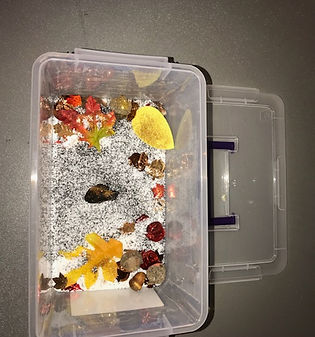
As part of my ECED 233 Emerging Literacy course during the Fall semester of 2017, I completed my mastery learning project. This project consisted of learning about the details of literacy and what literacy is as a whole. Literacy is not only reading; it can be writing and understanding the basic concepts of turning a page in a book. During this project, I created a Family Literacy Kit. The first step to completing this project was to find a book about the theme I had chosen and read it to my peers. I completed a lesson with my practicum class to go along with the theme I chose for story time. My lesson plan consisted of three centers that had to do with literacy skills. I created two take-home activities that included instructions for the parents. Parents and children completed an evaluation form about how they liked the activities. This is an impactful way for parents to understand what their child is doing in class and what they're learning about.
Analysis of What I Learned:
Through the completion of my Family Literacy Kit, I learned how to be more organized and to not procrastinate when doing these projects. I learned how to expand my knowledge and to think outside of the box when I was trying to find literacy-based activities. I would say the hardest part for me was for others to understand what I was trying to say in my lesson plan and that it would not make complete sense if it was given to a substitute. Many times, I tend to think inside the box, and I overthink what I want to say or want to do when writing activities. If I would try to incorporate something different in this project, I would want to be able to make a new theme, expand new ideas for the centers, and incorporate new take-home activities to make a unit for a couple of weeks that the children would enjoy. This project helped get the children’s families involved in their curriculum and create positive relationships with the teachers. For this project, I chose to incorporate Lev Vygotsky as my theorist because he talks about the benefits of play and how the children can use their imagination by learning. Vygotsky’s theory promotes the social interaction between the parent and the child. The take-home kits promoted social interaction because the parent was reading to their child and helped them comprehend each activity when sitting down to work together.


How This Artifact Demonstrates my Competence on the NAEYC Standard:
My competence was proven in this standard by the evaluations the parents and children filled out at my practicum site. I better understand the approaches necessary and the tools to influence family relationships. The resources helped me create this project. I used Pinterest to look up some ideas to get a better understanding of what I was supposed to do as I was researching what types of activities I wanted to use. The child I had chosen to do the take-home activities had a lot of fun. He learned how to use the different tools to understand his letters and cut them out. This is proven by each child’s ability with the different types of domains used in the curriculum. The children who did this activity should have used their literacy, cognitive, and social/emotional skills to be able to hit the major spots in what the children at my practicum site should be learning. I used inquiry tools to create my lesson plans and the curriculum. When I implemented my learning centers in my practicum classroom, I noticed that these centers were letting the children learn how to problem solve and explore. This also demonstrated my competence by promoting positive development as well as the different domains and content areas each child could learn from.
