Standard 1
NAEYC Standard:
STANDARD 1. STANDARD 1. PROMOTING CHILD DEVELOPMENT AND LEARNING
Candidates prepared in early childhood degree programs are grounded in a child development knowledge base. They use their understanding of young children’s characteristics and needs, and of multiple interacting influences on children’s development and learning, to create environments that are healthy, respectful, supportive, and challenging for each child.

Brief Description of Evidence:
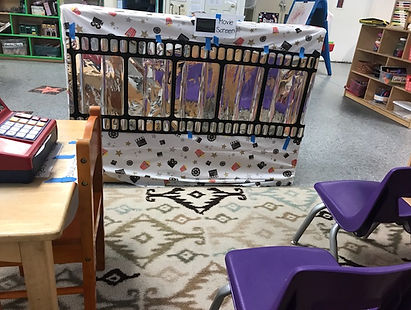
As part of my ECED 235 Preschool Practicum course, during the Fall semester of 2017 I completed a center transformation. The first step was to think of a theme to remodel in my Practicum classroom. Next, I communicated with my classroom mentor and told her what my theme was and thoughts; on how to transform my center into something spectacular. The theme I had chosen was a movie theatre, I wanted to transform the dramatic play area into something fun and exciting for children to engage in. The dramatic play area was only a kitchen area for the children, but it had been a kitchen for a long time. For this project, I had a movie area, and a sign that hung up that said "movie theater” on it, and I had the Hollywood stars and put each child’s name on a star. I created two lesson plans that helped the children comprehend what to do when working at a movie theater, and what kind of roles there are at a movie theater. The children got to experience how to work in a movie theater, and they comprehended each role and what they do. In the second lesson plan, which we did as a whole class, I helped each child understand what the 5 senses were, and I documented what each child said about their own project, which they made to create popcorn out of cotton balls, and put butter on their cotton balls. As part of this project, I was able to observe each individual child and in doing these lessons, each child participated in both activities (NAEYC, 2010).
Analysis of What I Learned:
Through completion of the center transformation, I learned that you can transform any classroom into a theme every other week. When changing the theme often, it engages children to want to play and explore in that learning center. Every child wants something different to play in, and not the same dramatic play area they have always had. This project helped me understand the importance of how each child’s mind forms differently, and how each child learns differently. Having every child problem solve is an important role because it teaches every child to learn and grow. As a teacher, this transformation taught me how to be creative in the classroom, and when I was setting up the movie theater every child helped me. As a teacher, I enjoyed creating these lesson plans and transformations for my practicum classroom. The theorist I had chosen for my center transformation was Lev Vygotsky because imaginative play is normal in a child’s development. Play based learning requires the children to make sense of their worlds, thinking skills, and their language towards each other. Vygotsky’s theory of cognitive development helps each child’s learning by transforming through the external world, and understanding what is happening when they are playing house or movie theater. Each child creates their own story in the dramatic play area and it teaches them about the different sorts of cultures, communicating, and they often mimic adults.


How This Artifact Demonstrates my Competence on the NAEYC Standard:
My competence in this standard is proven by coming up with lesson plans that engaged every child in. The children put so much time and effort into their activities because they enjoy each activity in class. The children communicate very rapidly, because they problem solve, and learn while playing. I recognize each child’s weaknesses and strong skills, while they create their activity, and while in the dramatic play area. Seeing the change from a child at the beginning towards the end of the semester helped me understand the concept of what kind of goals each child needs to work on, and how every child had grown in their social skills, fine motor skills, gross motor skills, and physical skills. As a teacher, I feel that every child learns differently and no one learns the same way, and each child helps me grow as a teacher to help every child’s needs. Every child has that teacher that wants their students to succeed in their classroom, and I believe that in my Practicum classroom I had met many of the children’s needs and they are more than prepared to move on to Kindergarten. As a teacher, I make an important difference in every child’s life, and I may not know it.


Lessons


