Standard 3
NAEYC STANDARD:
3. OBSERVING, DOCUMENTING, AND ASSESSING TO SUPPORT YOUNG CHILDREN AND FAMILIES
Candidates prepared in early childhood degree programs understand that child observation, documentation, and other forms of assessment are central to the practice of all early childhood professionals. They know about and understand the goals, benefits, and uses of assessment. They know about and use systematic observations, documentation, and other effective assessment strategies in a responsible way, in partnership with families and other professionals, to positively influence the development of every child (NAEYC, 2010).


Brief Description of Evidence
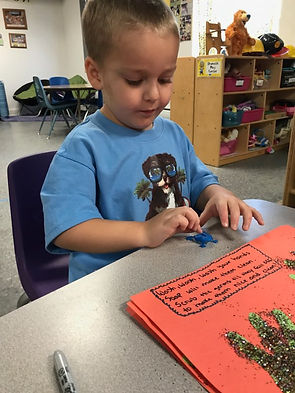
As part of my ECED 235 Preschool Practicum course during the Fall semester of 2017, I completed my Child Portfolio. I observed and documented and used other assessments to accomplish individualized goals for a student in my classroom. With help from my mentor and the child's family feedback, I was able to highlight strengths and needs for my student. After gathering the needed information, I focused on areas where the student needed the most guidance. Along with my mentor, I provided activities that targeted his specific needs such as letter recognition, handwriting skills, and recognizing numerals 1-10. Being able to help my student achieve his goals explains his growth from the beginning of the semester to the end of the semester.
Analysis of What I Learned:
Through completion of the Child Portfolio, I learned that connecting with families, is an important role when becoming a teacher. During the assessments I evaluated him over, I recognized a way to interact with the child and the family. Every time the child’s parent came and got him, I realized that I needed to show the parent what her child had been learning and how he has grown since the beginning of the semester. Showing the parent what their child is achieving gives the teacher a better grasp on their relationship and ways to bring their family closer, and have the relationship with the teacher as well. Many children feel that they do not belong in school, and they never want to communicate with other children, so I believe that teachers need to make the child feel connected and feel important when going to school. I learned how to put together goals and artifacts during this project. In the beginning, I had no clue how I was going to start this project, until I proceeded to conduct research; then I put the pieces together of the information I had obtained. This project helped me become more aware of children and family when completing the Portfolio. This helped me connect with the child each and every day. I tied my Child Portfolio with the theorist, Bronfenbrenner, because working with a child and helping them grow is an important goal, and Bronfenbrenner discusses how everyone has a circle of people in their everyday lives. He discusses the systems based on growth as a child and how you do not know anyone except for your family.


How This Artifact Demonstrates my Competence on the NAEYC Standard:
My competence in this standard is proven by the ten artifacts that I completed with my practicum student. I used the assessment Ages and Stages to measure his abilities on what he was strong and weak in. In whatever area he was strong in, I would touch base on some of that to see his ability. This proves my standard by observation, documentation, and other forms of assessment that is essential. During the Child Portfolio as an educator, I understand the goals, benefits, and uses of assessment. As an educator, I included observations and documentation for the child to complete to see where they are in their growth. As an educator, I gained the importance of assisting what the child needs, and help the child keep growing as they achieve each goal.